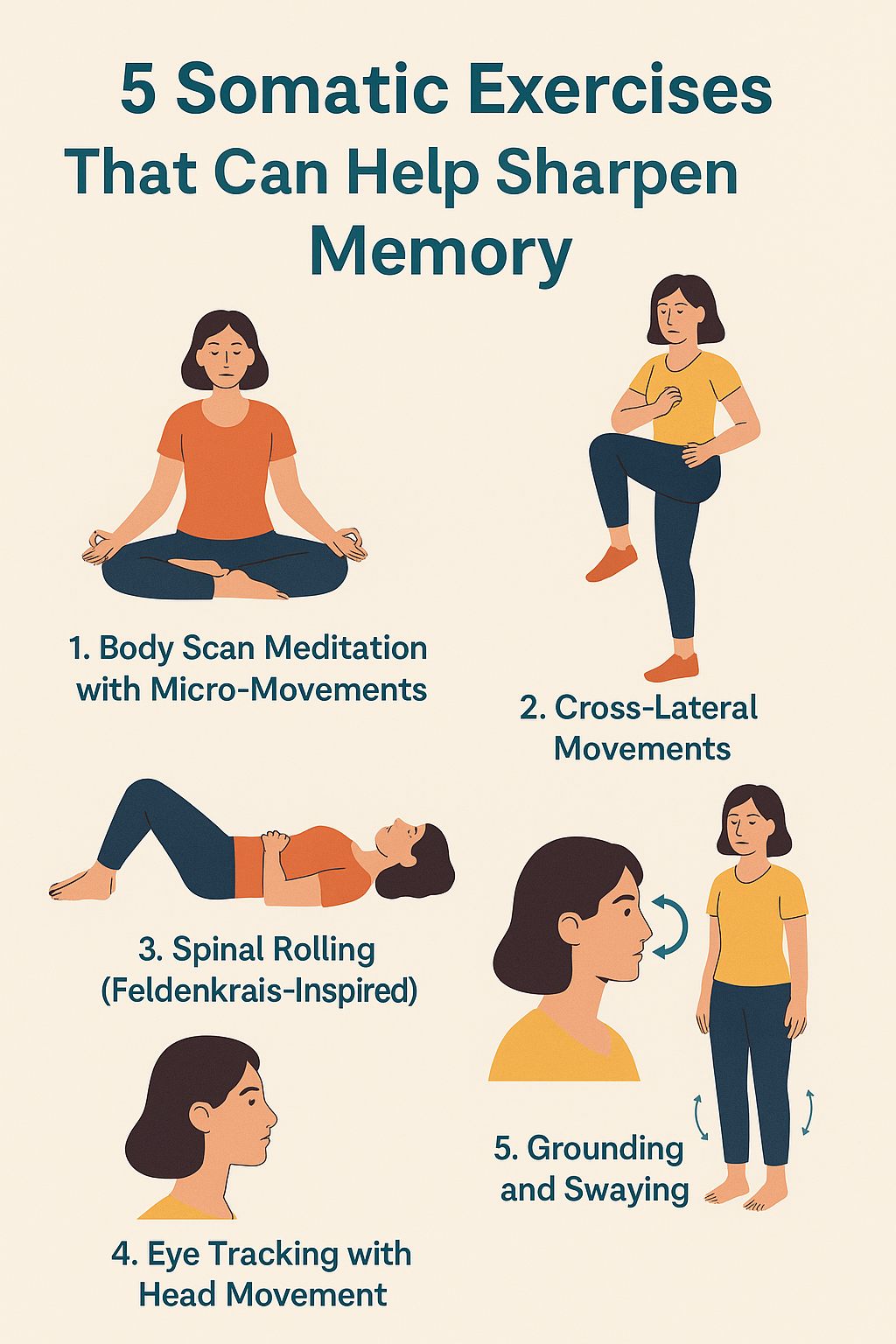
In an era dominated by digital distractions and information overload, memory problems are becoming increasingly common—not just among the elderly but also in younger populations. While many turn to brain games, supplements, or medications for cognitive enhancement, a lesser-known yet profoundly effective approach lies in somatic exercises.
Somatic exercises involve conscious movement and body awareness to release tension, improve physical function, and foster a stronger mind-body connection. These gentle movements not only enhance posture and mobility but also boost cognitive function, particularly memory.
In this article, we explore 5 powerful somatic exercises that can help sharpen your memory, how they work, and how to practice them for maximum benefits.
What Are Somatic Exercises?
Somatic exercises are movements performed with full awareness, focusing on internal sensations rather than external performance. The term “somatic” is derived from the Greek word “soma”, meaning the living body in its wholeness. These exercises stem from techniques such as:
- Feldenkrais Method
- Alexander Technique
- Hanna Somatics
- Body-Mind Centering
Unlike traditional workouts that aim to build muscle or burn calories, somatic exercises work through the nervous system to release chronic muscular tension and re-educate movement patterns. Since the brain and body are deeply interconnected, improving bodily awareness can significantly boost cognitive processes like memory, focus, and clarity.
The Science Behind Somatics and Memory
Our memory functions depend on the hippocampus and prefrontal cortex—areas that are highly responsive to sensory and motor inputs. Studies show that mindful movement and body-based awareness stimulate these brain regions by:
- Enhancing neuroplasticity (the brain’s ability to form new connections)
- Increasing blood flow and oxygen supply to the brain
- Reducing cortisol levels (stress hormone known to impair memory)
- Improving sleep, which is critical for memory consolidation
Thus, incorporating somatic exercises into your daily routine can create a fertile ground for optimal brain health and better memory retention.
5 Somatic Exercises to Improve Memory
Let’s dive into the top 5 somatic exercises that are proven to sharpen memory and promote holistic well-being:
1. Body Scan Meditation with Micro-Movements
What It Is:
This exercise involves slowly scanning your body with attention from head to toe while gently engaging in subtle movements to release tension and improve sensory awareness.
How to Practice:
- Lie down on a flat surface or sit comfortably.
- Close your eyes and bring your attention to your breath.
- Begin scanning your body from the crown of your head down to your toes.
- As you reach each part, make small, slow movements (e.g., rotate the wrists, flex the toes).
- Notice the sensations without judgment. Stay present.
Memory Benefits:
- Enhances body-mind integration
- Improves proprioception and sensory memory
- Reduces stress-related memory blockages
2. Cross-Lateral Movements (Crawling or Marching)
What It Is:
Cross-lateral movements involve opposite sides of the body moving together—like touching your left elbow to your right knee. These movements engage both hemispheres of the brain, improving communication between them.
How to Practice:
- Stand tall with feet shoulder-width apart.
- Lift your right knee and touch it with your left elbow.
- Return to center and repeat with the opposite side.
- Continue for 2–3 minutes in a rhythmic, mindful way.
Memory Benefits:
- Stimulates the corpus callosum (bridge between brain hemispheres)
- Enhances coordination and cognitive processing
- Strengthens short-term and working memory
3. Spinal Rolling (Feldenkrais-Inspired)
What It Is:
A gentle movement technique that brings awareness to your spinal alignment. It improves posture and breath function, directly supporting mental clarity.
How to Practice:
- Lie on your back with knees bent and feet flat on the floor.
- Gently roll your pelvis up and down, moving vertebra by vertebra.
- Focus on each segment of your spine.
- Add breath: inhale while arching slightly, exhale while curling.
Memory Benefits:
- Supports spinal health and oxygen flow to the brain
- Improves concentration and attention span
- Stimulates brain-body neural pathways
4. Eye Tracking with Head Movement
What It Is:
This exercise trains the vestibular and visual systems by synchronizing eye and head movements. It improves brain coordination and sensory integration.
How to Practice:
- Sit comfortably and focus on a point in front of you.
- Keep your eyes fixed while turning your head slowly left and right.
- Reverse: Keep your head still and move your eyes left to right.
- Try drawing imaginary shapes with your eyes (e.g., circles, figure-eights).
Memory Benefits:
- Enhances visual memory and spatial awareness
- Sharpens attention to detail
- Reduces mental fatigue and improves learning capacity
5. Grounding and Swaying
What It Is:
This somatic grounding exercise calms the nervous system and activates the brain’s parasympathetic functions—rest and digest mode.
How to Practice:
- Stand barefoot (preferably on natural ground).
- Feel the weight of your body rooted to the earth.
- Gently sway side to side or front to back.
- Stay aware of the sensations in your feet, knees, and spine.
Memory Benefits:
- Calms overactive brainwaves
- Promotes present-moment awareness
- Encourages deep memory integration and retention
Bonus Tips: Enhancing Somatic Exercises for Memory
To maximize the benefits of these exercises, consider the following tips:
- Practice daily for at least 10–15 minutes
- Combine with breathwork to deepen awareness and reduce stress
- Stay hydrated to support brain function
- Avoid multitasking while doing the exercises—stay fully present
- Use calming music or nature sounds to enhance relaxation
Who Can Benefit from Somatic Exercises?
These exercises are suitable for:
- Students struggling with focus or recall
- Seniors wanting to prevent cognitive decline
- Professionals dealing with burnout and brain fog
- Anyone recovering from trauma, stress, or anxiety-related memory issues
Whether you’re in your 20s or your 70s, somatic practices offer a gentle, accessible way to nourish your memory and reconnect with your body’s intelligence.
Conclusion: Memory Lives in the Body
We often think of memory as residing solely in the brain, but science and somatics tell us otherwise. The body holds memory, both consciously and subconsciously. Through consistent somatic exercises, we can access these stored patterns, enhance neuroplasticity, and build a sharper, more resilient mind.
By integrating body awareness into our daily routine, we not only improve our memory but also deepen our connection to ourselves and the present moment. Start small, stay consistent, and let your body lead the way.
FAQs
Q: How long before I see memory improvement with somatic exercises?
A: With daily practice, most people notice changes in mental clarity and recall within 2–4 weeks.
Q: Can these exercises replace cognitive training or supplements?
A: They complement other techniques beautifully but are most powerful when combined with a holistic approach including nutrition, rest, and mental exercises.
Q: Are somatic exercises safe for people with injuries or mobility issues?
A: Yes. Most movements can be adapted and are non-strenuous. Always consult a professional for personalized guidance.